






Do you suspect that your employee has not worked the hours they claim to have worked? That they are deliberately recording their hours incorrectly? In such cases, this is referred to as working time fraud. It is a controversial topic that has become increasingly relevant in recent years due to the rise of home offices and remote working. However, working time fraud often remains hidden because it is difficult to prove. Is working time fraud grounds for dismissal or even a criminal offence? How can you protect yourself against working time fraud? How can you prove working time fraud? We shed light on the issue and provide answers to all these questions.
The important stuff in brief
- Working time fraud refers to the deliberate presentation or falsification of working hours that were not actually worked.
- Working time fraud occurs, for example, when working hours are deliberately falsified, break times are not recorded correctly or overtime that has not actually been worked is reported.
- Working time fraud constitutes a breach of duty and a criminal offence, which may result in criminal sanctions in addition to consequences under labour law.
- Working time fraud may justify termination without notice. If there is no concrete evidence, dismissal on suspicion is also possible, subject to various requirements.
Since working time fraud is very difficult to prove, a private investigator should be called in to gather objective evidence and provide conclusive proof of the fraud.
What is working time fraud?
Under their employment contract, employees and workers are obliged to work at their place of work. The employer remunerates them for the time they spend doing so. In return, the employer expects the employee to perform work in accordance with labour law. This mutual obligation arises from § 611a BGB, which deals with employment contracts. Working time fraud in the broader sense is therefore any activity that prevents the employee from performing their duties.
Definition of working time fraud:
Working time fraud refers to the deliberate falsification or misrepresentation of working hours that were not actually worked. This can happen, for example, when employees leave early or arrive late but claim full working hours. Such behaviour can have consequences under labour law and damage the relationship of trust between employer and employee.
When does working time fraud occur?
Working time fraud can be committed by both employees and employers.
Working time fraud by employees
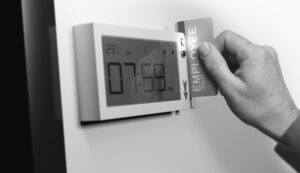
A classic example of working time fraud is the manipulation of time clocks.
Working time fraud by employees occurs when they deliberately manipulate their working hours. A classic example is the manipulation of time clocks. But it is not only such obvious forms of deception that count: if an employee surfs the Internet or makes private phone calls during working hours, they are also in breach of their employment obligations. This is because during this time, they are being paid by their employer for leisure activities that are not provided for in their employment contract.
Another point regarding working time violations is repeated and significantly late arrival at work. Employees should take factors such as rush hour traffic and transport delays into account in their planning. Everyday activities such as going to the toilet, fetching a cup of coffee or a brief chat with colleagues do not count as working time violations.
In general, the decisive factor is the intention of the employee. If they deliberately intend to deceive, this constitutes working time fraud. An accidental misrepresentation of working hours is not fraud, but merely a working time violation or breach.
Working time fraud by employers
An employer can also violate labor law. If supervisors do not pay employees for all hours worked, this also constitutes working time fraud. Compensation for overtime can also be granted in the form of time off. The automatic deduction of overtime from wages is only permissible if it has been agreed in writing and is within reasonable limits. However, if employers manually reduce the working hours of employees in the system while they are still working, this constitutes a violation.
What constitutes working time fraud? – Examples of working time fraud among employees

Typical examples of working time fraud by employees in the office, home office, industrial plant, or workshop include
- False statements regarding overtime/extra hours
- Repeated unexcused absences
- Repeatedly arriving late to work
- Frequent leisure activities, such as regular private internet use or phone calls
- Leaving the workplace without proper documentation or agreement
- False information in time sheets (hours not worked are recorded as worked)
- Too many and too long breaks
- Deliberate technical manipulation or misuse of time recording
- No reworking of unworked hours
Is time theft grounds for dismissal?
Working time fraud can have serious consequences for employees. If an employer discovers such fraud, they are entitled to issue a warning to the employee. This measure not only requires the employee to behave correctly, but also signals that further misconduct due to working time fraud will result in dismissal.
However, proven working time fraud can lead to termination even without prior warning. In extreme cases, termination without notice due to working time fraud is even possible. In this case, the employment relationship ends immediately, especially if the employee has acted persistently or with considerable deception over a longer period of time.
If the working time fraud cannot be clearly proven, but there is reasonable suspicion, dismissal on suspicion may occur after hearing the employee.
Is time theft a criminal offense?
According to criminal law, working time fraud is a criminal offense. Providing false information regarding working hours constitutes a criminal offense under § 263 StGB (German Criminal Code). If your employer files a complaint, a criminal investigation could be launched against you.
The statute of limitations is based on the penalty specified in the law according to § 78 StGB. If the penalty is up to five years, § 78 (3) No. 4 StGB stipulates a limitation period of five years. After this period has expired, criminal prosecution of the offense is no longer possible.
How is working time fraud punished?

Working time fraud can be punished both financially with a fine and with up to 5 years’ imprisonment.
In cases of working time fraud by employees, penalties ranging from a fine to a prison sentence of up to five years may be imposed. In reality, however, charges are rarely brought and the public prosecutor’s office is often not even informed of the facts. Even if investigations are initiated, a conviction or penalty order is usually only issued in particularly serious cases. This is conceivable, for example, in the case of intensive criminal activity or deception that goes far beyond just a few hours.
From the employers’ perspective, the situation is somewhat different:
In order to reduce tax and social security contributions, shorter working hours could be reported to the tax office as “agreed.” This can be considered tax evasion by the company, resulting in additional tax claims and, in the worst-case scenario, even imprisonment or custodial sentences.
What can be done to combat working time fraud?
Working time fraud can be committed by both employees and employers and represents a significant breach of trust. To combat such fraud, the following steps and measures should be considered:
- Clear rules: Establish clear and transparent guidelines for recording working hours. Employees should know exactly when and how to record their working hours.
- Introduction of time recording systems: Modern time recording systems can help prevent manipulation. They often offer features such as fingerprint scanners or facial recognition.
- Communication: Promote an open working environment in which your employees can address concerns and ambiguities regarding working hours without fear of reprisals.
- Regular checks: Carry out random checks on time sheets to ensure that everything is being recorded correctly.
- Training: Educate your employees about the importance of accurate time recording and the consequences of time fraud.
- Legal advice: In the event of reasonable suspicion of time fraud, we recommend that both employees and employers seek legal advice.
- External help from a detective: In cases that are difficult to prove, consider hiring a detective or other external monitoring authority to clarify the situation.
Preventive measures, clear communication, and regular checks can effectively curb working time fraud. It is important to create an environment of trust in which such fraud is less likely to occur.
How can working time fraud be proven?
As an employer, do you suspect that one of your employees is deliberately providing false information about their working hours? Or have you noticed that your employer has not paid you for all the hours you have worked? Then you are probably asking yourself: How can I prove working time fraud?
How can I prove that an employee is committing time fraud?
It is definitely not easy to prove working time fraud beyond doubt. Providing conclusive evidence is usually a real challenge. The ideal scenario would be if you, as an employer, caught the employee “red-handed” deliberately falsifying their working hours, for example in the time recording system. However, this is rarely possible.

In times of home offices and flexitime models, it is becoming increasingly difficult to prove working time fraud.
It is particularly difficult to provide clear evidence in modern working structures, such as flexitime models, where the start and end of the working day vary. Similarly, working from home or in the field poses difficulties for employers when it comes to proving working time fraud. In such cases, how can you ensure that the reported working hours correspond to the work actually performed?
For this reason, some employers resort to dismissal on suspicion. This is a dismissal that is pronounced even though the specific allegation of working time fraud cannot be conclusively proven. Such a dismissal clearly demonstrates a massive loss of trust in the employee, but can withstand legal scrutiny.
Nevertheless, if you as an employer have concrete suspicions but want solid evidence of fraud and do not want to terminate employment based on suspicion alone, it makes sense to seek professional help. A private investigator can help you uncover the fraud and provide solid evidence.
As experts in the field of working time fraud, our detectives throughout Germany are experienced, discreet, and quick to assist you. We will find out for you whether working time fraud is taking place and, if so, provide you with solid evidence.
Arrange a free initial consultation by phone nowHow can you defend yourself against your employer in cases of working time fraud?
If employees suspect that their employer is committing working time fraud, they have various options for protecting themselves and taking action against their employer:
- Involve the works council: In companies with a works council, employees should definitely inform it of their suspicions. The works council is responsible for representing the interests of employees and can mediate in disputes between employers and employees. It also has access to certain documents and can assist in clarifying the case.
- Documentation: It is important to document any discrepancies that arise in relation to working hours yourself. This includes, for example, photos of time cards, your own records of working hours, and any communication with supervisors.
- Talk to colleagues: Often, it is not just individual employees who are affected by such manipulations. By talking to colleagues, you can get a clearer picture of the situation and possibly take joint action.
- Legal action: If you are convinced that your employer has altered the time records in their favor, you can file a lawsuit with the labor court. In this case, you should seek advice and representation from a lawyer specializing in labor law. They can help you examine the case in detail and develop an appropriate strategy.
- Private investigator: Hiring a private investigator can be particularly useful when it comes to gathering evidence of tampering with the time recording system or other discrepancies. It is important that the investigator always proceeds discreetly so as not to alert the employer to the investigation prematurely.
Overall, it is very important to remain calm and act deliberately if you suspect your employer of working time fraud. It is important to seek legal advice and know your rights. Every employee has the right to fair and accurate accounting of their working hours.
The safe solution: private detective for working time fraud
A private investigator can be a valuable tool for employers in uncovering working time fraud. Thanks to their specialized training and experience, they are able to conduct investigations inconspicuously and discreetly.
One of the main tasks of a detective in such cases is to surveil the employee in question. This involves documenting when and where the employee carries out their activities, especially outside of regular working hours or the workplace. This can be used to determine, for example, whether an employee who works from home or in the field is actually working the hours they report.
Another advantage of working with a private investigator is their ability to gather evidence that will stand up in court. Professional surveillance technology, such as cameras and recording devices, can be used to obtain clear evidence that will provide clarity in cases of doubt.
In addition, a detective can also discreetly interview witnesses, gather information about the employee’s daily routine, or check their online activities, as far as this is legally permissible.
Overall, a private investigator’s expertise, methodology, and techniques provide essential support to employers in uncovering working time fraud and providing legally admissible evidence.
It also makes sense for employees to hire a private investigator to prove that their employer is committing working time fraud. This is because the investigator can conduct professional investigations to secure evidence of manipulation or discrepancies in time recording.
Case study: Working time fraud in the home office – using the company laptop for your own business
Mr. M., who had been working for a company for five years, showed a decline in work performance in recent months, which was initially explained by the switch to working from home. After a steady deterioration, the managing director hired detectives who suspected working time fraud. While monitoring Mr. M.’s residence, the detectives followed his wife to the airport and discovered that she owns a company in Milan. After contacting the company in Milan, they came across Mr. M. himself. He was using his employer’s company laptop to conduct business for his wife’s company. This case illustrates that even when working from home, time fraud can be uncovered through the professional work of detectives.
Conclusion
Working time fraud by employees or employers is a serious offense that should not be tolerated. Even in times of home office and flexible working, detectives still have a chance when it comes to detecting working time fraud, unfair competition, or similar offenses. If you suspect that your employees are not always behaving honestly, we at PRIMECHECK Detective Agency can help you professionally and discreetly!
We combine discretion, expertise, and speed and are always there for you at 18 locations in Germany and throughout Europe. Contact us now for a no-obligation, free initial consultation by phone!
Non-binding offer